
There is a logical fallacy called "appeal to authority." This is the act of claiming one's own opinion is correct simply because "an authoritative person" holds the same view. However, the truth or falsity of a statement should be judged based on whether the statement itself is reasonable, not on the basis that "an authoritative person said so"—that is logically invalid.
The "appeal to authority" fallacy comes in various forms depending on who is designated as the "authority." Examples include:
① People in positions where social obedience is expected, such as parents, teachers, bosses, or elders
② Professionals or figures we tend to trust vaguely, such as doctors, educators, researchers, writers, or celebrities
③ Religious figures such as monks, cult leaders, or deities
In everyday life, we often see "fake authorities" being invoked with phrases like "everyone is saying it" or "it's overflowing on the net." These carry no evidentiary weight whatsoever for proving truth or falsity. If we allow convenient cherry-picking of public opinion to serve as authority, anyone can affirm their own views with complete freedom.
And astonishingly, this "fake authority" has even begun to dominate the pages of newspapers. In a special feature column by Tokyo Shimbun's senior editor, the paper wrote: "'China, who do you think you are?' 'Onward, 100 million fireballs!' 'Japanese citizens, become kamikaze pilots!' The net is overflowing with such bombastic words," and then criticized the media for needing to "put the brakes" on such "frenzy." However, the claim that "the net is overflowing with…" later turned out to be based on misinformation.
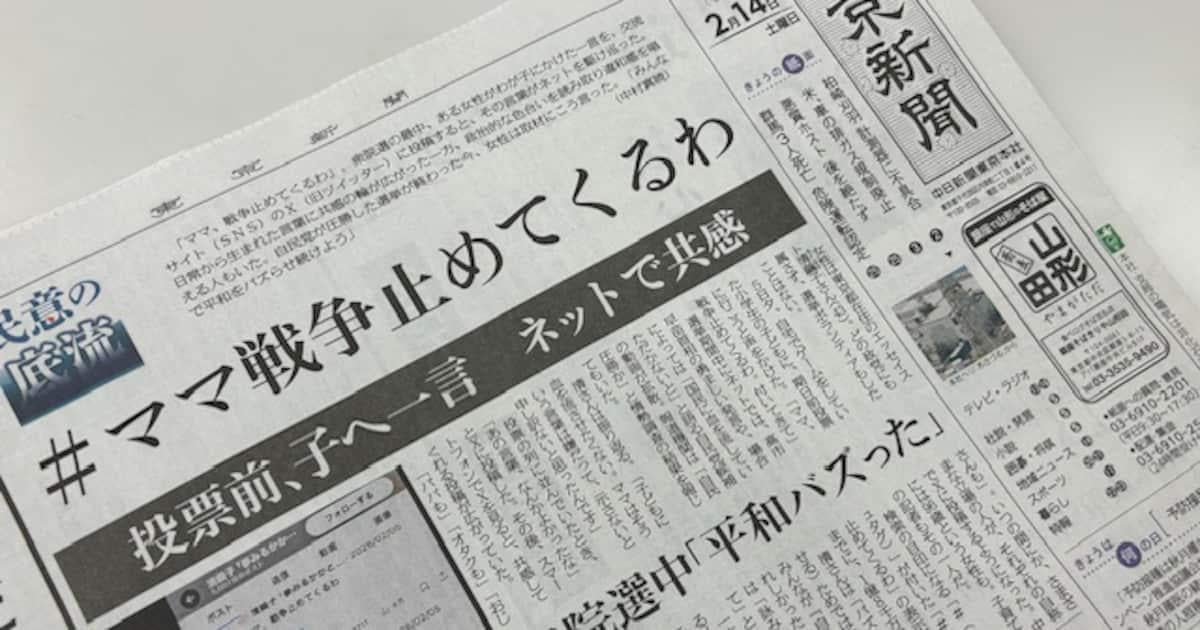
During an election period, the hashtag "#MomWillGoStopTheWar" spread on the net, and the newspaper ran it as a front-page top story, reporting that "Dads too," "Otaku too," "Uncles too," and people from various walks of life were expressing "sympathy" online. Yet the proper role of journalism should not be to uncritically affirm such "frenzy," but rather to calmly analyze whether there is any actual risk of war behind such extreme premises.
In yet another column, the paper published emotional assertions such as: "'Takaichi depression' is flying around the net," "For non-supporters, [voices supporting Sanae Takaichi] are hell. It wrecks your mental health," and "The gap between moderate civic awareness and violent election results breeds despair." Using malicious, slanderous online expressions that treat a politician as if she were a mental illness, and then denying the election outcome from a victim's perspective, constitutes insidious human rights abuse and, at the same time, a denial of democracy.
By selectively picking up internet discourse to divide society, Tokyo Shimbun is significantly eroding the credibility of mass media.
by Bright_Fuel2271