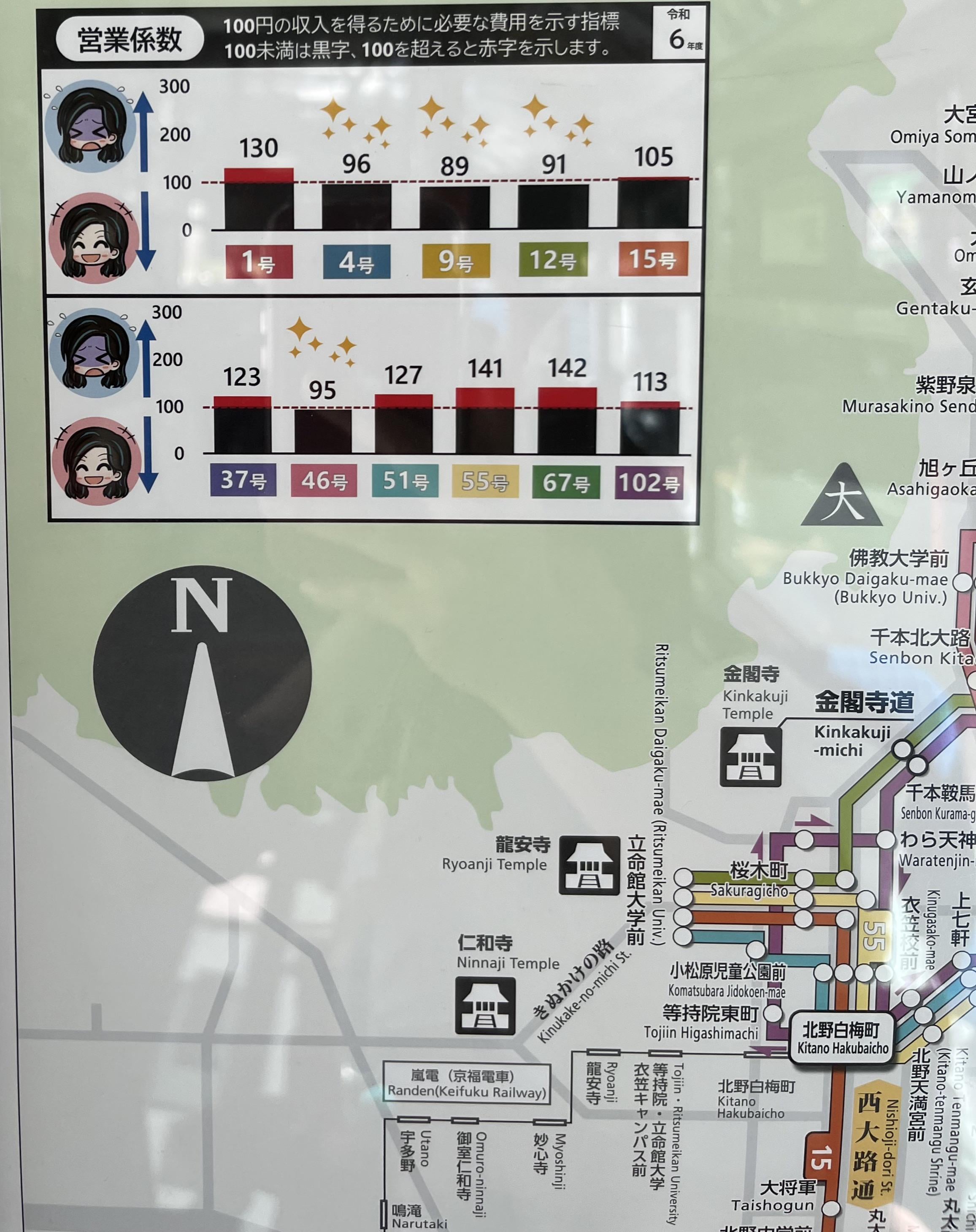
I saw this chart on Kyoto bus and still can’t fully understand after google translate. I’m curious what it is and can anyone let me know?
by Lazy-Try-5704

I saw this chart on Kyoto bus and still can’t fully understand after google translate. I’m curious what it is and can anyone let me know?
by Lazy-Try-5704
5 comments
Meaning they are in the RED running all those buses
It is a graph measuring how much is costs the city to make 100 yen for each bus line. If it costs more than 100 yen, they are losing money, if it costs less, they are making money.
Basically, it tells you how much spending is needed to make 100 Yen profit, with numbers below 100 indicating a profit. I always interpret this in a very neoliberal way. The way I read this is: “look at all the tax money that is necessary to run public transport, with so much lines operating at a loss!”
The European in me would like to have Kyoto City understand that public transport requires certain lines at a loss, while others may run a huge profit. Even lines are a crucial lifeline for local citizens even when they operate at a loss. Also, they seem to not understand that companies like Hankyu or Keihan make their money in real estate, not transport.
Nevermind the hundreds of thousands of Yen I pay in taxed to Kyoto City ever year.
The Kyoto City Transportation Bureau publishes the “operating ratio”—a metric reflecting the financial performance of each city bus route—annually to help citizens understand the current state of the city bus system and encourage greater use of the service.
We are pleased to announce the operating ratios for fiscal year 2024 as follows.
The operating ratio is an indicator showing the cost required to generate 100 yen in revenue. A ratio below 100 indicates a profitable route, while a ratio above 100 indicates a route operating at a loss.
Kyoto City Transportation Bureau
Kobe has been printing the cost of bus routes on the timetables for a few years now.
Last month they reduced the number of buses across the board, including the heavily used routes that were operating at a profit.
The official explanation for the cuts was “look at the shiny trinket we are building in Sannomiya. Shiny, isn’t it. I like shiny things and so do you. Trinkets are good…”
(Edited to fix a couple of autocorrect mistakes)
Comments are closed.